Many dealers already have access to co-op marketing funds. The problem is that available money can remain hidden in a portal, trapped behind unclear rules or lost to deadlines. A dealer does not need another generic marketing idea. It needs a clear path from funds available to campaign live to claim approved to business outcome understood.
PowerChord's March 2026 article makes the point directly: dealers often do not fail to use co-op funds because they lack motivation. They fail because the process is difficult to navigate. The brand has requirements, the dealer has limited bandwidth and the claim depends on documentation that is often assembled too late.[1]
That challenge is especially relevant to automotive co-op marketing. Dealer groups manage multiple rooftops, OEM rules, approved vendors, creative standards, local offers, inventory changes and reimbursement windows. Without a shared operating model, every campaign becomes a new administrative project.
The Funds Are Often There. Visibility Is Not.
PowerChord recommends starting with the brand's dealer portal or the OEM representative. The basic questions are simple: What is the current balance? What activities are eligible? When do the funds expire? What is the reimbursement rate? Is pre-approval required? Which administrator handles the claim?
These questions should not depend on one busy store employee remembering to log in. In a mature automotive co-op marketing operation, fund balances, deadlines, eligibility and ownership should be visible in the same planning rhythm as inventory and media budgets.
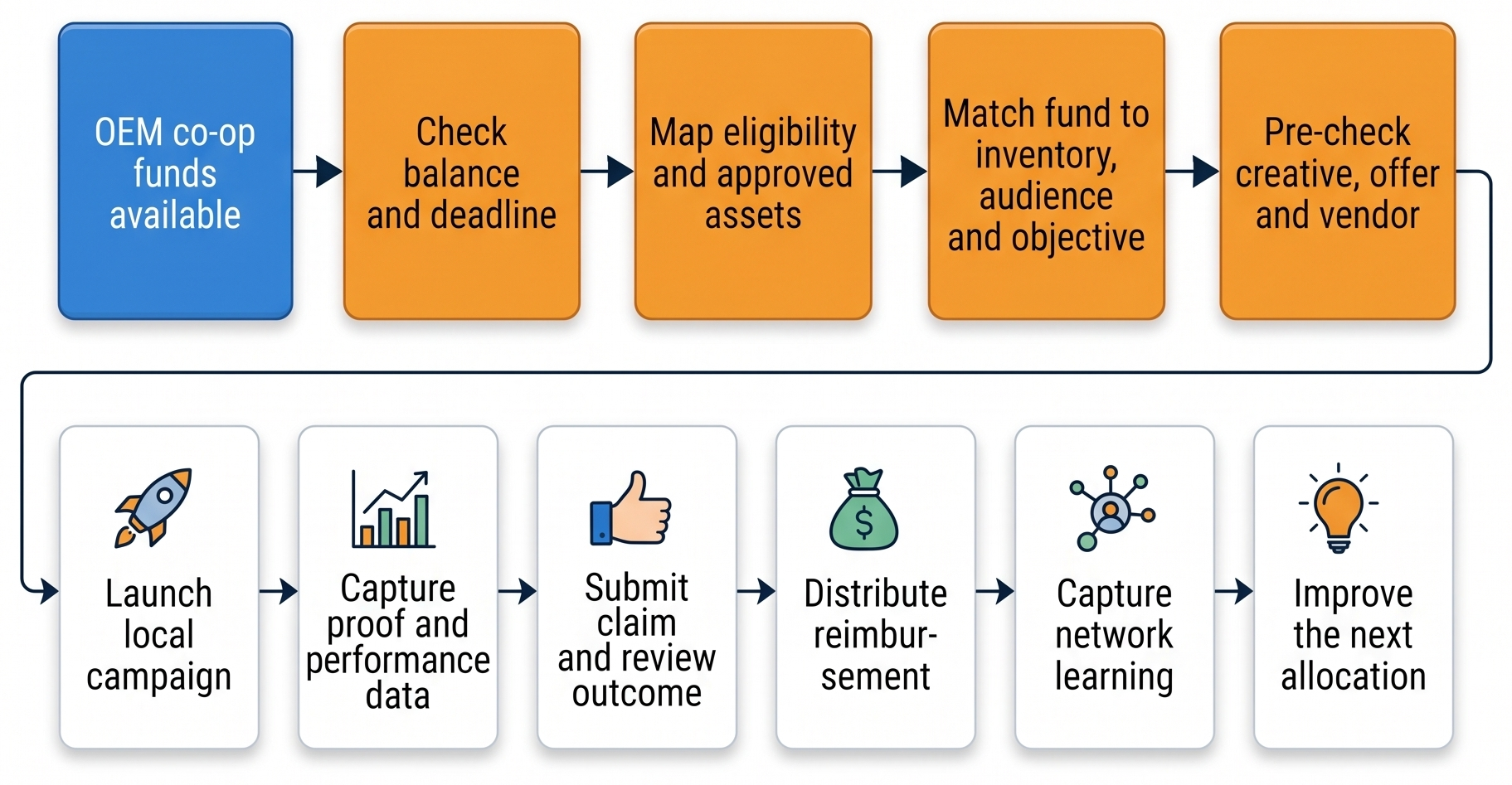
Available funds are not yet usable funds. Usability begins when the dealer knows what can be spent, where, by whom and by when.
Why Dealer Co-Op Funds Go Unused
The source identifies three recurring barriers. First is compliance complexity. A campaign can be well intentioned and still be rejected if the creative, vendor, offer, logo treatment or documentation does not meet the current program rules.
Second is creative access. Dealers may not have current brand-approved assets or may be uncertain about how far they can customize them. That uncertainty can lead to risky local production—or no campaign at all.
Third is bandwidth. A reimbursable claim can require pre-approval, final creative, invoices, delivery records, screenshots, reporting and formal submission. For a dealer team focused on sales, service and operations, the claim is easy to postpone until the deadline has passed.
AIM-COM™ thesis: Co-op fund utilization is an operating-design problem. Make the next compliant action obvious, and more of the available budget can reach the local market.
Where Automotive Co-Op Marketing Can Work Hardest
PowerChord highlights paid search, social media advertising and local SEO as channels that can meet buyers while they are actively researching. The logic is strong for automotive dealer marketing: a consumer searching for a specific model, dealership or service near a location is already signaling intent.
That does not mean every dollar should move to one channel. It means the co-op strategy should connect channel choice to the commercial objective. New inventory may need demand creation. Aging inventory may need a focused offer. Service may need local search visibility. EV and hybrid campaigns may need education as well as conversion.
| Commercial objective | Possible automotive co-op marketing role | Control needed |
|---|---|---|
| Generate demand | Paid search, social and local SEO around current inventory. | Accurate inventory, offer language, audience and conversion tracking. |
| Improve local visibility | Location-based content, listings and brand-approved creative. | Consistent dealer data, approved assets and local relevance. |
| Support a model launch | Campaigns that combine education, consideration and lead capture. | OEM messaging, disclosures, model details and approval workflow. |
| Protect fund utilization | Planned campaigns tied to balances and expiration windows. | Ownership, calendar controls, proof and claim reconciliation. |
Simple example: an aging SUV inventory campaign
A dealer identifies 18 eligible SUVs with inventory older than 60 days. The team checks its OEM balance, confirms that paid search and social are eligible, uses approved model assets, routes the offer for review and launches a local campaign. The campaign record stores the approval, final creative, invoice, delivery report and lead-quality signal. The next allocation is based on what moved inventory—not only on impressions.
How AIM-COM™ Helps Solve the Process
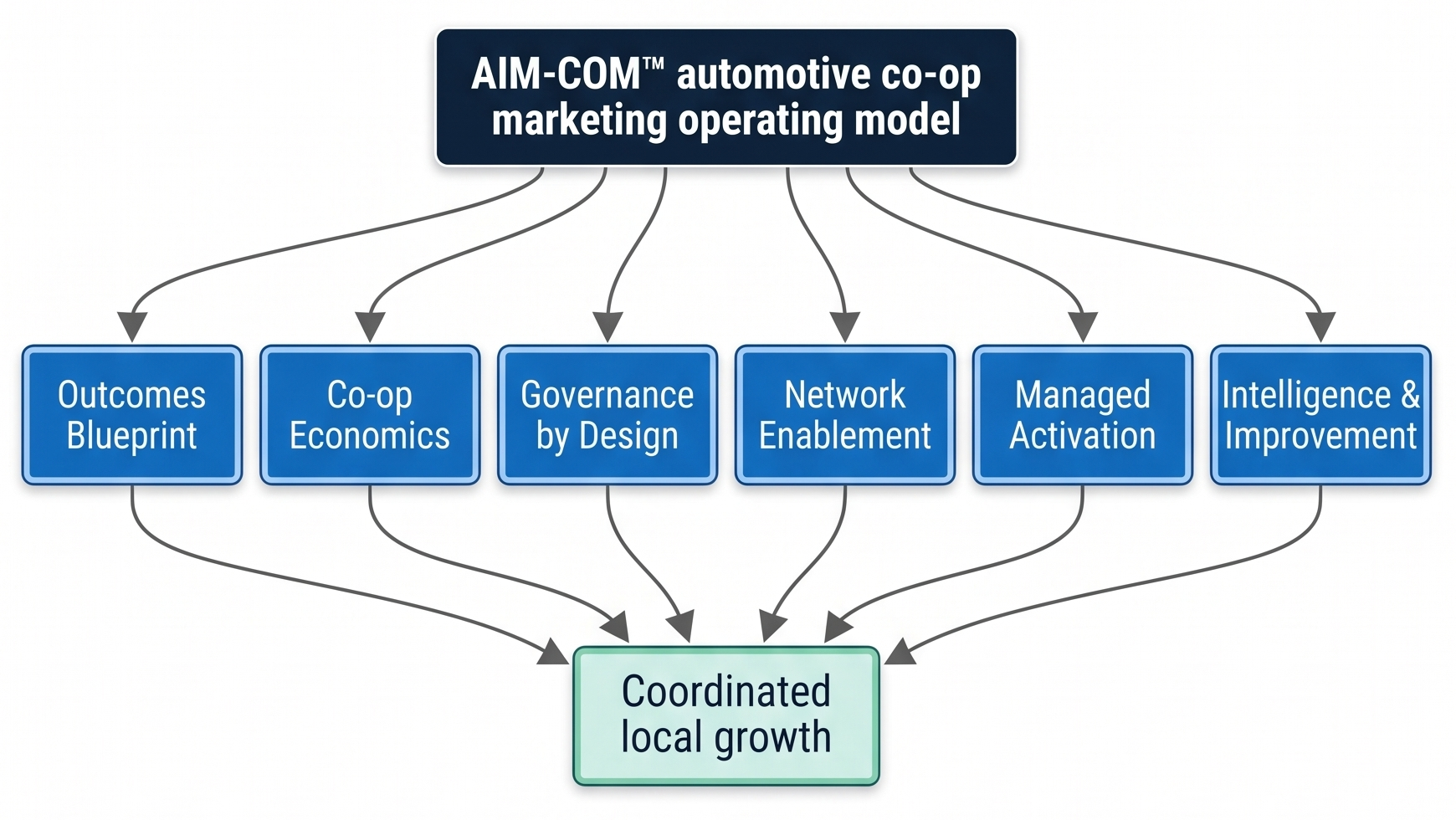
AIM-COM™ brings a governance layer to automotive co-op marketing. The goal is not to add bureaucracy. It is to remove avoidable uncertainty so dealers can act faster and program owners can see what is happening across the network.
1. Fund visibility
Centralize balances, accruals, expiration dates, reimbursement rates and responsible owners.
2. Eligibility intelligence
Translate OEM rules into practical checks for media, creative, vendors, offers, audiences and evidence.
3. Campaign activation
Match funds to inventory, market conditions and buyer intent, then move approved campaigns into market.
4. Evidence by design
Capture approvals, final assets, invoices, placements and performance records while the campaign runs.
5. Continuous improvement
Separate delivery metrics from business signals and use the learning to improve the next allocation.
For dealer groups, this creates a repeatable operating model across rooftops. For OEMs, it creates stronger visibility into adoption, compliance and local activation. For local marketing teams, it provides a practical playbook instead of another disconnected checklist.
The AIM-COM™ Advantage
The methodology connects six capabilities: strategy, co-op economics, governance, network enablement, campaign activation and marketing intelligence. That combination matters because co-op funds cross organizational boundaries. Finance sees the budget. Marketing sees the campaign. Compliance sees the rules. The dealer sees the deadline. AIM-COM™ connects those views into one operating cycle.
The result is commercially simple: more clarity before launch, fewer avoidable claim problems, faster use of eligible funds and better evidence of what local marketing is accomplishing.
Recent Integration: SaaS Co-Op Marketing Workflows with Microsoft Copilot
Recently, I coordinated the integration of a SaaS tool focused on automotive co-op marketing with Microsoft Copilot. The objective was practical: help marketing teams reuse what already worked, align local plans with OEM media priorities and coordinate regional actions without starting every plan from a blank page.
In the workflow, Copilot Pro was used for faster performance in research, drafting and comparison tasks. Commercial Data Protection was applied to approved business workflows to help protect organizational prompts and data according to the applicable Microsoft product and account terms. In practice, this supports a safer operating environment: commercial content is handled within the intended protection boundary, prompts are not treated as public material, and the team can apply access, review and retention controls around the work.
The up-to-40% figure is an internal optimization estimate for selected recurring planning activities, not a guaranteed outcome for every team or campaign. The gain comes from reducing repetitive work: locating prior plans, summarizing results, identifying reusable structures, comparing OEM media plans and preparing a first draft for human review.
What the integration can do in a dealer-network context
| Use case | Copilot contribution | Human control |
|---|---|---|
| Plan reuse | Find patterns in previous plans and results, then draft a new plan structure. | Confirm that the prior result is still relevant to current inventory, budget and OEM rules. |
| OEM alignment | Cross-reference a local plan with an OEM media plan and flag possible gaps. | Validate the current OEM policy, eligible channels and required approvals. |
| Regional coordination | Group local actions by market, timing, audience and shared creative opportunity. | Protect local relevance and approve the final activation calendar. |
| Competitive analysis | Review public competitor websites for messaging, offers, SEO structure and customer experience patterns. | Use only public information, avoid copying protected content and interpret findings commercially. |
Simple example: from prior results to a new plan
Prompt: “Review the last three approved regional dealer plans and their results. Compare the reusable tactics with this OEM media plan. Identify gaps by market, recommend a draft channel mix and list every item that requires current compliance validation.”
Copilot can return a structured first draft. The marketing owner then checks inventory, budget, claims language, approved assets, privacy requirements and dealer capacity before anything is activated.
Built-in safeguards and legal support
Copilot should be used as an assistant inside a governed process. Built-in safeguards are designed to reduce unsafe or inappropriate outputs, but they do not make every answer correct. Users still need to verify facts, protect confidential information, respect permissions and keep a human approval step for external communications, claims and high-impact decisions.
Microsoft's Customer Copyright Commitment may provide legal support for certain copyright claims involving eligible customer use of Copilot-generated content, subject to the applicable service terms, eligibility requirements and customer safeguards. It is not a blanket permission to copy competitor content or ignore third-party rights. The practical AIM-COM™ rule is simple: use Copilot to analyze public patterns and create original work, keep source records, and route sensitive or uncertain material for legal and brand review.
My completion of Microsoft's Generative AI for Marketers course complements this implementation by strengthening practical understanding of GenAI history, capabilities, limitations, prompting, content analysis, competitive research and responsible marketing use.
Simple Copilot-assisted workflow
A marketer can ask Copilot to compare an OEM media plan with last quarter's approved plan, summarize what performed, identify reusable creative, review a competitor dealer website and draft a campaign brief. A human owner still verifies current OEM rules, inventory, claims language and final recommendations before launch.
Prompt example: “Compare this OEM media plan with our last three approved dealer campaigns. Identify reusable tactics, gaps in local coverage and questions we must resolve before submitting the next co-op claim.”
The Bottom Line
PowerChord is right to frame unused dealer co-op funds as a solvable process problem. Dealers do not need to become experts in every OEM portal or memorize every reimbursement rule. They need the right information at the right moment, the right assets, a clear owner and a reliable way to prove execution.
Automotive co-op marketing becomes more valuable when it is managed as a growth system rather than an annual reimbursement exercise. AIM-COM™ helps dealer networks turn co-op marketing funds into visible, compliant and measurable local action.
The money may already be there. AIM-COM™ helps make the path to growth easier to follow.
Reference
Make your co-op marketing funds work harder.
AIM-COM™ helps OEMs and dealer networks improve fund visibility, simplify compliance, activate local campaigns and measure the path from co-op dollars to commercial outcomes.
Explore the AIM-COM™ Approach