Stellantis is moving Chrysler, Dodge, Jeep and Ram dealers toward a minimum advertised pricing policy beginning October 1. The reported change is not simply a pricing rule. It is a co-op marketing and dealer-governance challenge: how do local teams protect brand integrity, stay inside the advertised-price formula, use approved digital providers and still compete for attention in a fast-moving market?
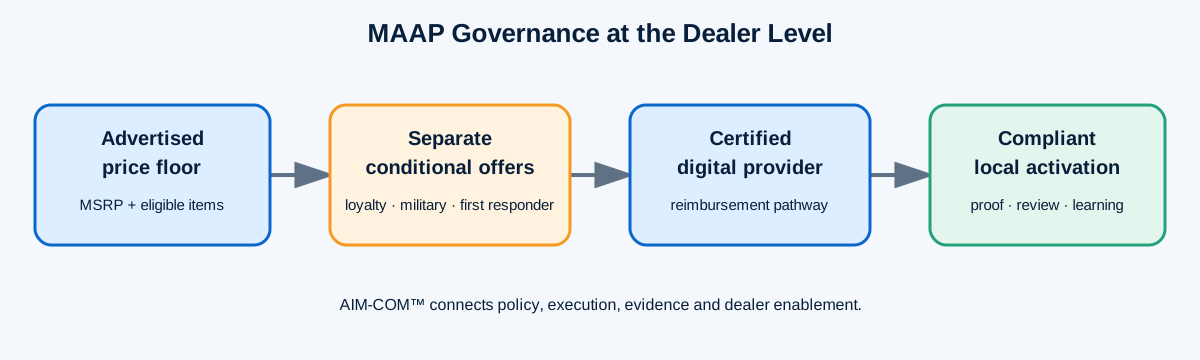
According to CBT News, the new Stellantis Marketing Covenant applies to advertised prices for new vehicles. Dealers may still negotiate a lower final transaction price after a shopper makes contact. The reported formula considers MSRP, certain dealer add-ons and accessories, a limited market adjustment, dealer discounts and universal incentives. Conditional incentives such as loyalty, military and first-responder offers must be handled separately from the main advertised price.[1]
What Changes for Dealer Marketing
The first change is the separation between an advertised price and the final transaction. A dealer can preserve room for negotiation, but the public offer must follow the covenant's formula. That creates a new review point for websites, paid search ads, social creative, third-party listings and campaign landing pages.
The second change is the reported reimbursement pathway. Beginning October 1, digital advertising reimbursement will flow only through certified providers. This makes vendor governance part of co-op marketing execution. A campaign can be commercially attractive and still create reimbursement risk if the provider, creative, documentation or submission path is not eligible.
The third change is competitive behavior. The covenant reportedly restricts dealers from advertising against another Stellantis dealer's doing-business-as name. Local marketing teams therefore need a clear view of competitor references, brand terms, offer language and geography before campaigns are approved.
Why the Price Floor Does Not End the Marketing Challenge
The rationale reported by CBT News is brand integrity and the prevention of misleadingly low promotional prices. The article also references concerns about mandatory fees and unusually deep discounts. A price floor can make the public offer more consistent, but it does not by itself generate demand.
Dealers may face slower foot traffic or more aged inventory if customers perceive less price flexibility. They can still compete after contact through service, transparency, availability, financing conversations, trade support, delivery experience and confidence in the buying process. The marketing system must therefore shift from “lowest advertised price” to “strongest compliant value proposition.”
AIM-COM™ thesis: A pricing covenant should be treated as a governed customer-experience constraint—not as a reason to stop innovating in local marketing.
Applying Module 3: Competitive Intelligence with Microsoft Copilot
Module 3 of the Microsoft Copilot marketing course focuses on using GenAI to scrutinize competitor actions, compare similar products and generate a living competitive-analysis report. The same method can support a Stellantis dealer network when it is applied to public information, documented sources and human review.
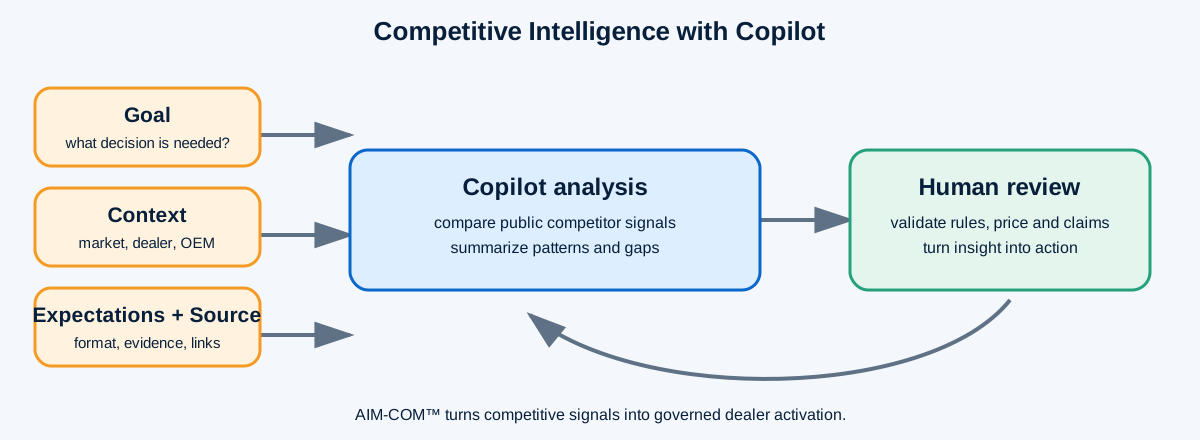
The module introduces four prompt-building blocks: Goal, Context, Expectations and Source. This structure is useful because a vague request such as “analyze competitors” rarely produces a decision-ready result. A governed request defines what decision the dealer needs to make, the market and OEM context, the required output and the source boundaries.
Prompt example: Stellantis local-market review
Goal: Create a competitive analysis for our Jeep-Ram dealer's next local campaign.
Context: Review public dealer websites and digital ads in our market. The Stellantis advertised-price policy begins October 1. We compete on service experience, inventory visibility and transparent offers.
Expectations: Provide an executive summary, three recurring competitor patterns, examples of compliant value messaging, risks to review and five recommended tests. Separate observations from assumptions.
Source: Use only public URLs, identify each source and flag any information that requires confirmation in the current Stellantis Marketing Covenant.
Copilot can help summarize public competitor messaging, identify recurring offers, compare landing-page structures, surface service promises and organize findings for the marketing team. It should not be treated as a substitute for current OEM policy, legal review, pricing approval or direct verification of a competitor's private data.
How AIM-COM™ Turns Insight Into Action
AIM-COM™ connects the policy, people, workflow and evidence required to make a new co-op environment workable. The objective is not to automate judgment. It is to reduce repetitive work and make the correct next action easier to see.
| Challenge | AIM-COM™ application | Dealer benefit |
|---|---|---|
| Advertised-price accuracy | Pre-launch checks for price formula, universal incentives, conditional offers, fees and disclosures. | Fewer avoidable corrections and clearer customer-facing offers. |
| Certified-provider control | Maintain approved-provider status, campaign ownership and reimbursement evidence. | Lower claim friction and stronger digital co-op accountability. |
| Competitive pressure | Use structured Copilot prompts to analyze public patterns and create a living market report. | Faster learning without copying competitor content or relying on assumptions. |
| Dealer enablement | Translate covenant rules into playbooks, examples, approval paths and escalation routines. | Local teams can act with confidence inside clear guardrails. |
| Performance learning | Connect approved creative, media delivery, customer response and inventory signals. | Better decisions about what to repeat, adjust or stop. |
Simple AIM-COM™ example: a Jeep campaign after October 1
A dealer wants to promote a Jeep model with aging inventory. The team first validates the public price against the covenant formula. It separates any loyalty or military incentive from the universal offer. It confirms the digital provider is certified, uses approved assets and runs a Copilot-assisted review of public competitor messaging. AIM-COM™ records the approval, source links, creative, provider, launch date and delivery evidence. The campaign then competes on availability, service, transparency and ownership experience—not on a non-compliant public price.
Governance Rules for Copilot-Supported Analysis
Copilot can accelerate analysis, but the output may contain errors, incomplete sources or outdated assumptions. AIM-COM™ recommends five safeguards: use public or approved inputs, request source links, separate facts from interpretation, require a human review for price and claims, and retain the final decision record.
Competitive intelligence should also respect copyright, privacy, terms of use and confidential information. The purpose is to understand market patterns and improve original dealer execution—not to reproduce a competitor's creative or scrape restricted data.
I completed Microsoft's Upgrade Your Marketing Strategy with Microsoft Copilot course, authorized by Microsoft and delivered through Coursera, on September 27, 2026. The module's practical exercises reinforce a principle that fits AIM-COM™: better prompts create better first drafts, but governed human decisions create accountable marketing.
The Bottom Line
The Stellantis MAAP change may constrain how dealers advertise price, but it does not eliminate the need for strong local marketing. It raises the value of coordinated governance. Dealer groups need a way to translate policy into campaign checks, approved-provider workflows, competitive learning and consistent customer experience.
AIM-COM™ provides that operating layer. By connecting co-op economics, governance, dealer enablement, managed activation and intelligence, it helps teams move from a new rule to a repeatable operating response.
When price flexibility narrows in public, the quality of governed activation becomes a larger part of the competitive advantage.
References
- CBT News — “Stellantis moves to minimum advertised pricing policy, effective Oct. 1.”, September 24, 2026.
- Coursera — Certificate verification for “Upgrade Your Marketing Strategy with Microsoft Copilot.”, completed September 27, 2026.
Turn dealer-policy changes into governed local growth.
AIM-COM™ helps OEMs and dealer groups translate co-op rules, digital provider requirements, competitive signals and local activation into one repeatable operating model.
Discuss a Governance Diagnostic