A dealership does not lose value only when a customer chooses another brand. It can also lose value when an owner misses a service interval, fails to respond to an appointment reminder or becomes inactive after the sale. Retention is therefore a commercial operating problem, not merely a loyalty slogan.
The FordDirect example is useful because it connects an approved vendor model with 24/7 customer engagement, inbound call handling, service appointment booking and outbound calls, texts and emails. Those capabilities sit close to the part of the dealership that often produces durable customer value: fixed operations.
This article does not assume that every Ford or Lincoln dealer has the same co-op balance, reimbursement rate or eligible use case. The practical question is narrower: could an eligible co-op allocation help a dealer make retention activity more consistent, more measurable and easier to fund?
Why Retention Is a Strong Co-Op Use Case
Traditional co-op conversations often start with new-vehicle advertising: model campaigns, promotional offers, local search and inventory demand. Those uses remain important. But the customer relationship continues after the sale, and the dealer has recurring opportunities to protect it through service reminders, recall communication, maintenance education and personalized outreach.
The economics can favor retention. The investment narrative used by AIM-COM™ references a retention cost of approximately $350–$1,000 compared with approximately $1,200–$2,500 for conquest. These ranges are planning references, not guarantees or FordDirect pricing. Their value is directional: a dealership may spend less to reactivate an existing relationship than to acquire a completely new customer.
Co-op funds can be more powerful when they help protect the customer relationship already created by the OEM and dealer.
What FordDirect-Eligible Engagement Can Support
The FordDirect page describes a vendor model built around several interaction types. For a dealer, those capabilities can be mapped to retention and fixed operations in a controlled way.
| Capability | Retention application | Dealer value to measure |
|---|---|---|
| 24/7 inbound call handling | Answer ownership, service and appointment questions when staff are busy or unavailable. | Answer rate, qualified conversations, appointments created and handoff quality. |
| Service appointment booking | Schedule maintenance and repair appointments around technician availability and store rules. | Booked appointments, show rate, repair-order volume and customer response time. |
| Recall and service outreach | Reach eligible or lapsed customers with timely, personalized reminders. | Contact rate, appointment conversion, completion rate and opt-out rate. |
| Outbound calls, texts and email | Re-engage inactive customers and prioritize high-potential ownership segments. | Reactivation, service return, revenue per customer and campaign cost. |
What This Could Represent for a Dealership
The answer depends on the dealer's customer base, service capacity, campaign eligibility, reimbursement rate and existing technology. A simple scenario can still make the decision easier to discuss.
Illustrative dealer scenario—not a FordDirect quote
Assume a dealership identifies $12,000 of eligible retention activity for a defined period and a hypothetical 50% reimbursement rate. The potential reimbursement would be $6,000, leaving an illustrative net dealer contribution of $6,000. If the activity recovers appointments that would otherwise be lost, the dealer can compare the net campaign cost with appointment volume, completed repair orders, customer retention and contribution margin.
The 50% rate is used only to explain the math. The dealer must confirm the actual FordDirect program rules, approved vendor status, eligible activity, claim documentation and reimbursement terms before spending.
| Illustrative item | Amount | How to interpret it |
|---|---|---|
| Eligible retention activity | $12,000 | Planning assumption for outreach, booking and related activation. |
| Hypothetical reimbursement | 50% / $6,000 | Illustrative only; confirm the current program rate. |
| Illustrative net dealer contribution | $6,000 | Amount to compare with measured appointments, repair orders and retention. |
| Decision threshold | Defined before launch | Set target cost per appointment, show rate, completed RO and evidence quality. |
The most important output is not the reimbursement itself. It is the relationship between fund use and business evidence. If the dealer cannot show what customers were contacted, which appointments were created, which visits were completed and what the campaign cost, the funding may be used without producing a defensible operating lesson.
Retention Versus Conquest: A Practical Economic Lens
Retention should not be positioned as a replacement for conquest. New customer acquisition remains necessary. The more useful question is where each dollar is most productive at a particular moment.
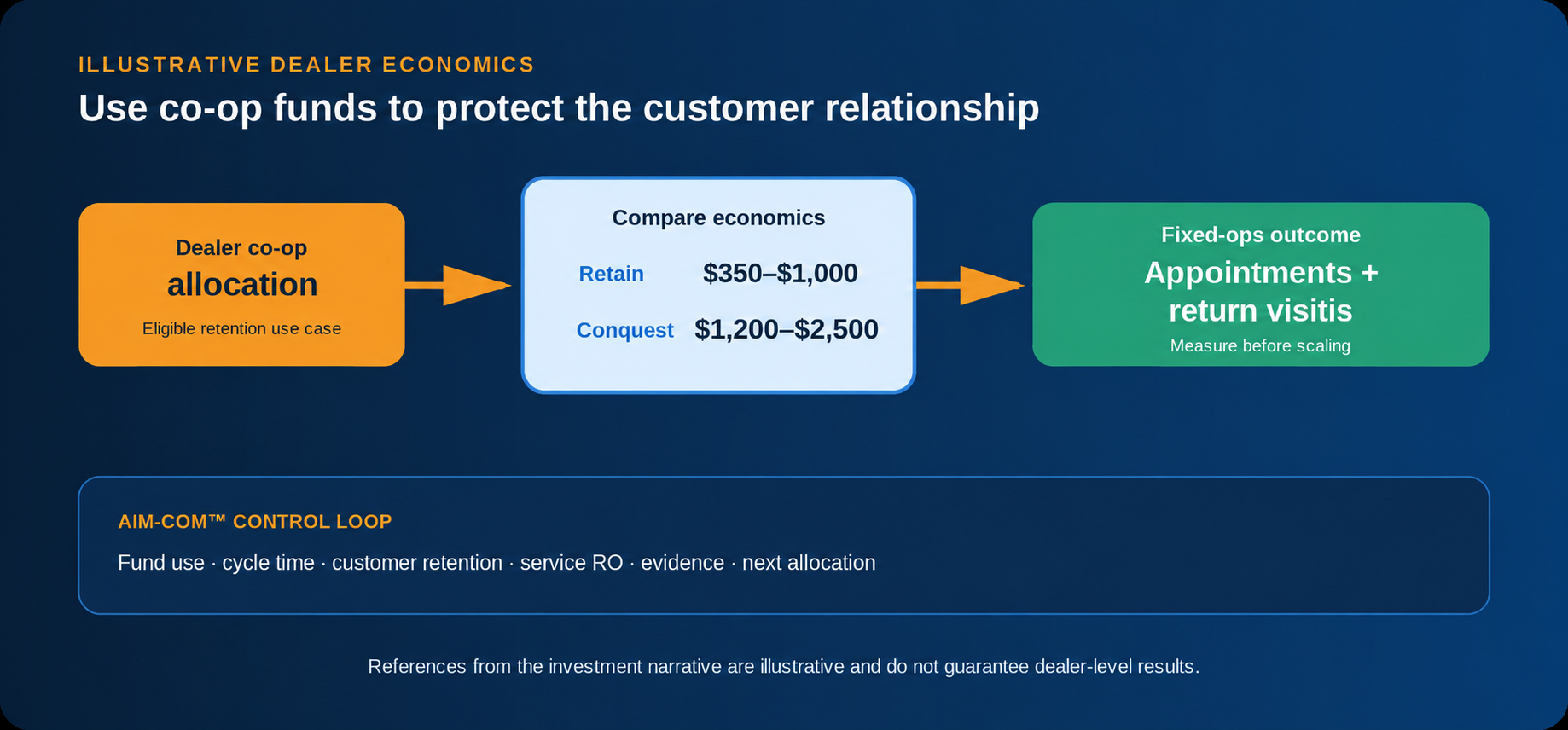
For a dealer with unused co-op funds, lapsed customers and available service capacity, a retention use case may deserve priority. For a dealer with a full service lane but weak new-vehicle demand, the balance may be different. AIM-COM™ helps make that choice explicit rather than applying one campaign formula to every rooftop.
How AIM-COM™ Can Govern the Opportunity
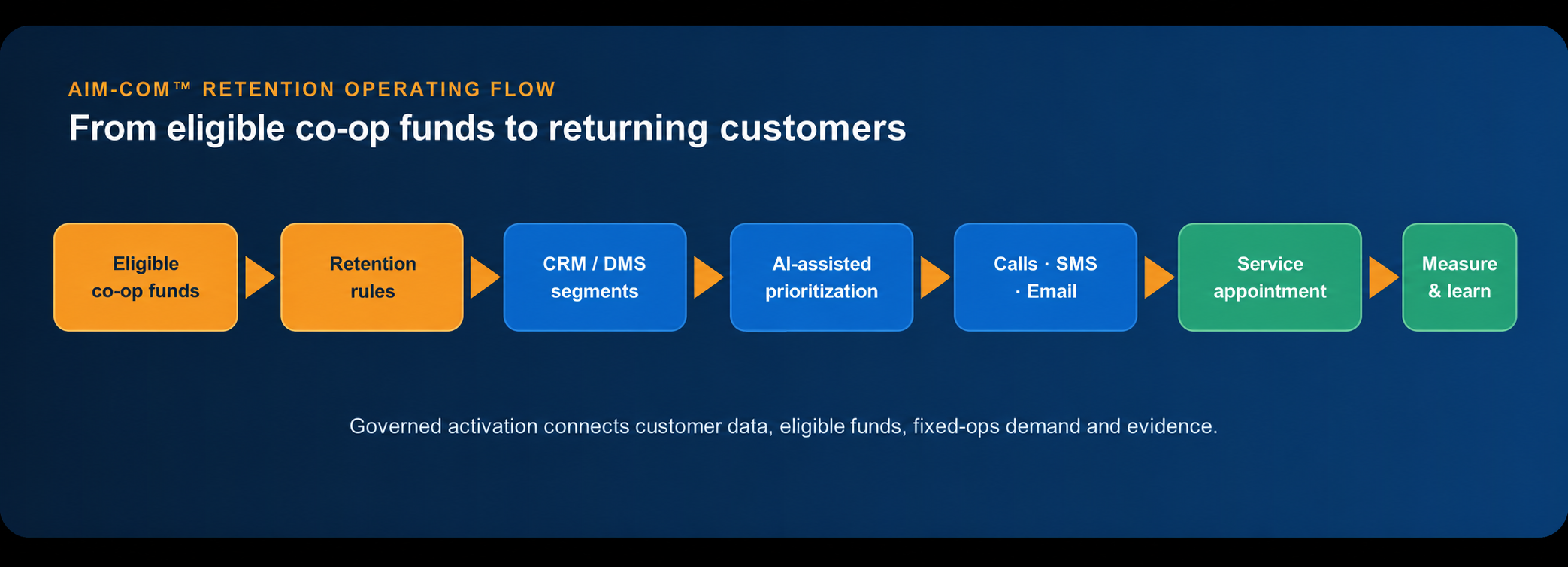
AIM-COM™ connects strategy, co-op economics, governance, dealer enablement, activation, evidence and optimization. Applied to a FordDirect-style retention program, the operating model can follow five steps.
1. Validate eligibility
Confirm the current co-op rules, approved vendor relationship, eligible services, customer permissions, reimbursement rate and claim window.
2. Define the audience
Use CRM, DMS or service data to identify lapsed customers, missed appointments, recall audiences and high-potential segments.
3. Activate responsibly
Coordinate calls, SMS, email and appointment booking around store policies, staff capacity and customer preferences.
4. Capture evidence
Store the approved plan, audience logic, messages, delivery records, invoices, appointment events and claim documentation.
5. Measure and improve
Compare fund use, cycle time, appointments, show rate, completed repair orders, retention and customer response.
Why Fixed Operations Changes the Conversation
Fixed operations can create recurring customer contact and more predictable opportunities to demonstrate value. A service appointment is not only a transaction. It can be a moment to restore trust, explain maintenance, identify a recall, improve the ownership experience and keep the dealership present in the customer's next decision.
The investment presentation cites a $406 gap between recommended and sold service repair orders as a signal of opportunity. That figure should not be interpreted as guaranteed revenue for an individual dealer. It does, however, illustrate why disciplined service communication and follow-up may deserve more attention in the co-op operating model.
When the dealer connects retention activity to fixed-operations capacity, the campaign becomes more than a message. It becomes a controlled business process with a measurable next step.
The Business Value to Track
| Value dimension | Possible KPI | Why it matters |
|---|---|---|
| Revenue generation | Completed repair orders, service revenue and contribution margin. | Shows whether activity creates measurable commercial outcomes. |
| Cost savings | Reimbursement captured, cost per appointment and avoidable claim rework. | Shows whether co-op reduces the net burden of activation. |
| Time savings | Response time, booking time and hours spent assembling evidence. | Shows whether automation improves dealer productivity. |
| Customer retention | Return rate, lapsed-customer reactivation and opt-out rate. | Shows whether the ownership relationship is strengthening. |
| Customer satisfaction | Appointment experience, response quality and follow-up feedback. | Ensures growth does not come at the expense of trust. |
Important Limits and Governance Questions
Co-op eligibility is not the same as guaranteed reimbursement. Before a dealer launches a retention campaign, it should confirm the current program documentation, approved vendor scope, eligible channels, creative or message requirements, privacy permissions, claim deadlines and evidence standards.
AI-assisted engagement also requires safeguards. The system should not invent service availability, promise pricing that has not been approved, contact customers without appropriate permission or make a financial claim that cannot be supported. Human teams remain responsible for exceptions, escalations, policy changes and customer-sensitive decisions.
AIM-COM™ principle: Use co-op funds to make retention repeatable, but use governance to make the outcome defensible.
The Bottom Line
FordDirect's strategic-vendor model points to a broader shift in automotive co-op marketing: eligible funds can support customer engagement and fixed-operations outcomes, not only awareness and new-vehicle demand.
For a dealership, the opportunity is not simply to spend more. It is to use an eligible allocation to reach the right customers, create service appointments, capture reimbursement evidence and compare the net cost with measurable retention and operating outcomes.
AIM-COM™ provides the coordination layer: validate the program, define the audience, activate the workflow, document the evidence and improve the next decision.
The strongest co-op campaign may be the one that helps a customer return before the relationship goes quiet.
References
- FordDirect strategic-vendor co-op program information and STELLA Automotive AI capability overview, accessed September 29, 2026.
- AIM-COM™ investment narrative and operating methodology, internal discussion material.
Turn eligible co-op funds into measurable retention.
AIM-COM™ helps OEMs and dealer networks connect co-op eligibility, customer data, service activation, evidence, reimbursement and fixed-operations performance.
Explore the AIM-COM™ Approach