The program offers an exclusive cash reward to eligible Farm Bureau members toward the purchase or lease of certain new Ford trucks and toward specified Ford Blue Advantage certified used vehicles. The program page also requires state, ZIP code and Farm Bureau member ID to access the certificates page.
The operational detail matters. The customer must prove membership timing and standing. The vehicle must fall within an eligible list. The dealer must participate. The transaction must meet the applicable delivery or order condition. And the offer cannot necessarily be combined with other Ford private incentives.
This is the type of campaign where a simple customer promise can require a disciplined back-office workflow. AIM-COM™ can provide the framework for connecting that promise to evidence, review, dealer adoption and a measurable next campaign.
A member benefit is not fully activated until eligibility, evidence, dealer execution and outcome measurement work together.
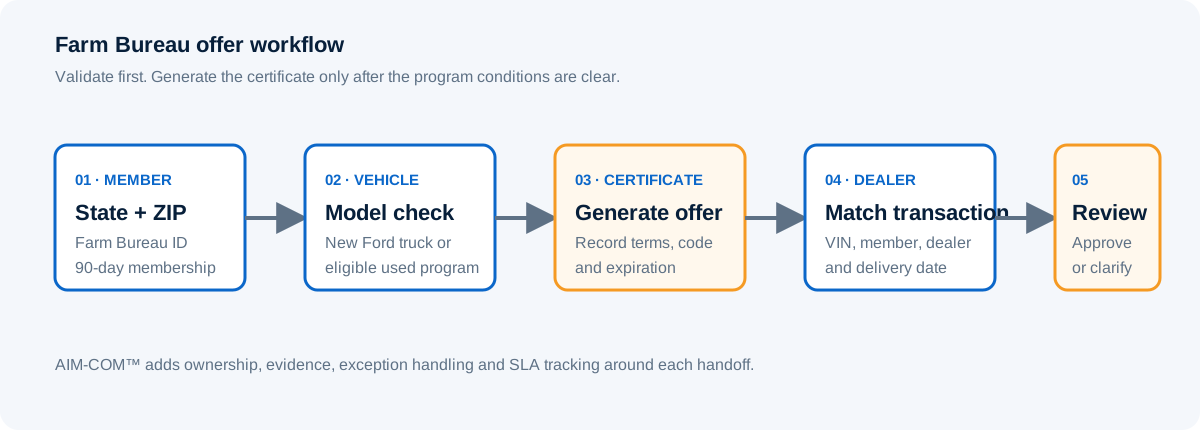
What the Current Program Details Require
The official program details identify active Farm Bureau membership for U.S. residents, 90 consecutive days of membership before purchase or lease and good standing at the time of sale. The listed new-vehicle scope includes the 2025, 2026 and 2027 model-year Ford Maverick, Ranger, F-150, Super Duty and F-150 Lightning, subject to the current Ford incentive program rules.
The page also lists a separate Ford Blue Advantage path for eligible 2021–2027 model-year certified used vehicles, with model, certification, mileage and state restrictions. The used-vehicle path is not interchangeable with the new-vehicle path. Each needs its own eligibility logic.
| Program area | Current detail shown on the program page | Operational control |
|---|---|---|
| Member | Active Farm Bureau member, U.S. resident, 90 consecutive days and good standing. | Validate member ID, state, ZIP, membership start date and standing. |
| New Ford vehicles | Eligible Maverick, Ranger, F-150, Super Duty and F-150 Lightning model years are listed. | Match VIN, model, model year and active vehicle eligibility. |
| Certified used | Specified Ford Blue Advantage vehicles with certification and mileage conditions. | Use a separate rule set for certification, model year, mileage and excluded states. |
| Dealer | Offer is subject to dealer participation and authorized Ford Dealer requirements. | Maintain a current participating-dealer list and escalation contact. |
| Timing | New retail order or delivery, and used delivery, are subject to the program end date shown in the terms. | Capture order, certificate and delivery timestamps. |
| Combination | May not be combined with most other Ford private incentives. | Review each additional incentive independently before approval. |
Important qualification
Eligibility and reward amounts can change with Ford incentive programs, vehicle availability, dealer participation and the active program number. This article is an operating analysis, not a replacement for the current official terms or dealer confirmation.
Where AIM-COM™ Could Help
AIM-COM™ could organize the Ford Farm Bureau workflow across six connected layers. The objective is not to add bureaucracy. It is to make the campaign easier to explain, easier to execute, safer to administer and more useful as a source of learning.
| AIM-COM™ layer | Farm Bureau application | Output |
|---|---|---|
| Strategy & Outcomes | Study eligible membership, regional truck demand, inventory, dealer capacity and competitive programs. | Defined goals for adoption, deliveries, customer value and dealer coverage. |
| Co-op Economics | Separate the member cash reward, program administration, dealer economics and campaign investment. | Visibility into planned, approved, paid and exception amounts. |
| Governance & Risk | Translate membership, vehicle, geography, timing and combination rules into testable criteria. | A versioned eligibility matrix and auditable decision history. |
| Network Enablement | Give dealers a playbook, FAQs, training, escalation rules and customer explanation. | More consistent adoption and fewer preventable submissions. |
| Activation & Operations | Coordinate certificate access, customer documents, dealer transaction and review queue. | A visible workflow from registration to final decision. |
| Intelligence & Improvement | Analyze adoption, penetration, exceptions, results, dealer feedback and regional differences. | A next-campaign playbook based on evidence rather than anecdotes. |
1. Start With a Market Study
Before launching communication, the campaign team could study where Farm Bureau membership overlaps with Ford truck demand, eligible inventory and dealer capacity. A state-level view would help identify regions where the offer has an available product, participating dealers and a realistic customer path. It could also reveal customer behavior patterns, such as which members need more explanation before requesting a certificate.
The baseline could include member population, historical Ford truck sales, inventory age, certified used supply, dealer participation, prior private-offer usage, competitor incentives and likely documentation capacity. These inputs would not predict sales by themselves. They would establish the context for a more defensible result study.
2. Define Rules and Eligibility Before Activation
The member experience should not depend on a salesperson interpreting a long page of conditions differently from another salesperson. AIM-COM™ could convert the official terms into a decision matrix.
| Decision | Question | Evidence |
|---|---|---|
| Member eligible? | Is the member active, in good standing and at least 90 days into membership? | Farm Bureau member ID, state, ZIP and membership record. |
| Vehicle eligible? | Does the vehicle match the current new or certified-used path? | VIN, model, model year, certification and mileage where applicable. |
| Transaction eligible? | Is the transaction a qualifying purchase or lease through an authorized participating dealer? | Dealer identity, transaction type and program confirmation. |
| Timing eligible? | Did order or delivery occur inside the applicable program window? | Order, certificate and delivery timestamps. |
| Combination eligible? | Is another private incentive being used that conflicts with the Farm Bureau reward? | Offer stack review and exception decision. |
3. Make Certificate Access a Controlled Handoff
The program page asks for state, ZIP code and Farm Bureau member ID to access the certificates page. That is a useful control point. A campaign workflow could record when the member requests or receives the certificate, which program path applies and whether the certificate has been used, canceled, expired or escalated.
Secure design matters. Personally identifiable information should be limited to authorized users, stored only as long as required and protected with an audit trail. The process should avoid unnecessary copies of member IDs or documents in email threads and uncontrolled spreadsheets.
4. Submit Evidence Safely
Evidence requirements should be clear before the customer arrives at the dealer. The workflow could collect only what is necessary to validate the decision, with a status that shows complete, missing, inconsistent, approved or rejected.
| Evidence | Purpose | Control |
|---|---|---|
| Farm Bureau ID | Connects the customer to the member record. | Restricted access, identity matching and secure retention. |
| Membership timing | Confirms the 90-day requirement and good standing. | Record source, validation date and reviewer. |
| VIN and vehicle data | Confirms model, model year and new or certified-used eligibility. | Structured match against the active vehicle matrix. |
| Dealer and transaction | Confirms authorized dealer, purchase or lease and participating status. | Use a current dealer directory and transaction type field. |
| Order or delivery | Confirms the timing condition. | Capture timestamp and retain evidence for review. |
5. Agree on SLAs for Review and Benefit Approval
AIM-COM™ could help stakeholders agree on service levels for each handoff. The actual times would need to be negotiated by Ford, the Farm Bureau program administrator and participating dealers.
| Stage | Example SLA definition | Measure |
|---|---|---|
| Intake | Confirm whether the submission is complete. | Time to acknowledgment and incomplete rate. |
| Review | Compare evidence with the rule matrix. | Median review time and first-pass approval. |
| Clarification | Explain missing or conflicting evidence. | Correction cycles and recurring reasons. |
| Approve, reject or escalate to an accountable owner. | Decision time, appeals and exception age. | |
| Benefit | Process the reward after final approval. | Approval-to-concession time and open approved cases. |
6. Use AI for Adoption and Penetration Reporting
AI could support recurring reports that compare member engagement and dealer execution by state, region, dealer group, rooftop, model path and time period. It could summarize where members accessed certificates but did not complete a transaction, where dealers have high submissions but high rejection rates, or where a region has low penetration despite eligible inventory.
Illustrative reporting prompt
“Analyze Farm Bureau campaign participation by state, dealer and vehicle path. Compare certificate access, complete submissions, approvals, rejected documents and final deliveries. Identify adoption gaps and the three most common operational causes. Do not decide eligibility or payment; flag cases for human review.”
The report should use de-identified or appropriately protected data and should preserve a human approval step for eligibility, compliance and benefit decisions.
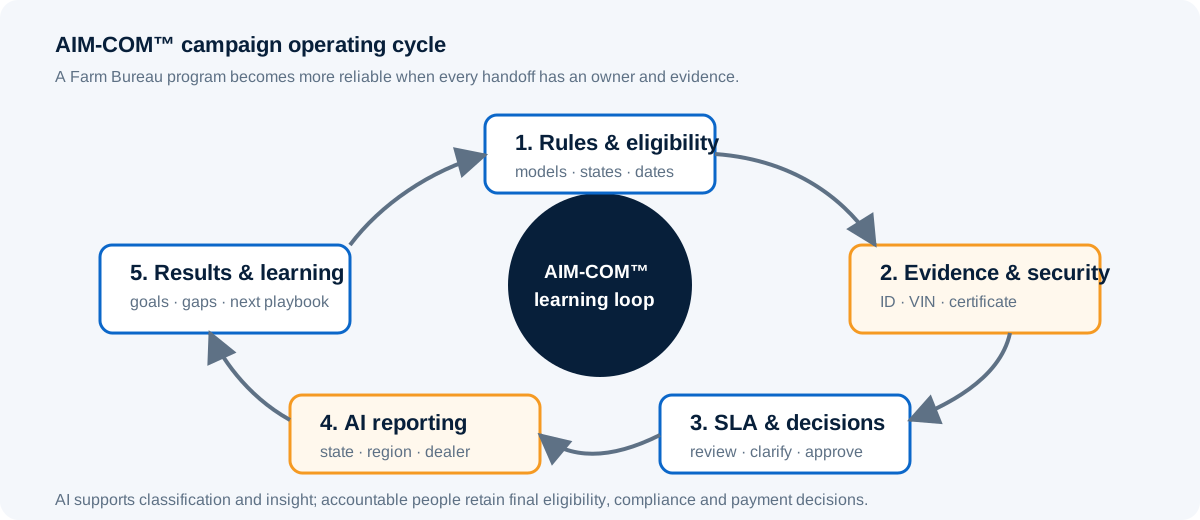
7. Measure Goals, Gaps and Dealer Experience
A successful campaign review should include more than the number of certificates issued. It should compare the original objectives with actual adoption, approvals, deliveries, processing time, dealer coverage and customer friction.
| Goal | Possible measure | Learning question |
|---|---|---|
| Member adoption | Certificate access, applications and completed submissions. | Where did members understand or abandon the process? |
| Dealer penetration | Participating rooftops, trained teams and active submissions by region. | Which dealers need enablement or a simpler handoff? |
| Vehicle mix | New versus certified-used paths, models and inventory context. | Did the eligible product match the audience’s demand? |
| Operational quality | Approval rate, rejection reasons, SLA time and escalation volume. | Which rule or document created the most friction? |
| Commercial outcome | Qualified leads, deliveries, inventory movement and cost context. | What changed beyond normal market and inventory conditions? |
| Unmet objectives | Targets below plan and regions with low penetration. | What should be redesigned rather than explained away? |
8. Research Dealers and Preserve Lessons Learned
A short dealer survey could ask whether the rules were clear, whether the certificate process was usable, whether the customer understood the offer, whether document submission was secure, whether the SLA was predictable and what would make the next campaign easier to execute.
Interviews should include sales, finance, BDC, administrators and managers. Their experience may differ. A dealer can have high customer interest but low completion because the document workflow is unclear. Another can have low participation because the eligible inventory is not aligned with local demand.
The final learning record should preserve changed rules, regional differences, repeated rejected-document reasons, SLA performance, dealer feedback, adoption gaps and the recommendations that will shape the next program.
The Bottom Line
The Ford Farm Bureau program is a strong example of why cooperative campaign governance needs to connect marketing, eligibility, documentation, dealer operations and measurement. The program page may explain the customer offer, but the operating system determines whether the offer is consistently understood, validated and executed.
AIM-COM™ could support the campaign from market study to post-campaign learning: define the rules, secure the evidence, agree on SLAs, analyze adoption with AI, research dealer experience and use both achieved and missed objectives to improve the next campaign.
The conservative conclusion is simple: the benefit alone does not create the result. The quality of the workflow around the benefit determines how much of its potential can be realized and explained.
The most valuable campaign evidence is not only the approved certificate. It is the complete record of what worked, what failed and what should change next.
Frequently Asked Questions
Who is eligible for the Ford Farm Bureau offer?
The program details state that active Farm Bureau members who are U.S. residents must generally have been members for 90 consecutive days and be in good standing at the time of sale. Eligibility is subject to the current official terms.
Which vehicles are included?
The current program details identify eligible new Ford Maverick, Ranger, F-150, Super Duty and F-150 Lightning vehicles, plus specified Ford Blue Advantage certified used vehicles. Exclusions and vehicle eligibility can change.
What information is needed to access certificates?
The program site requests the member’s state, ZIP code and Farm Bureau member ID to access the certificates page. The dealer and program administrator may require additional evidence for final validation.
How could AIM-COM™ support the workflow?
AIM-COM™ could organize market study, eligibility rules, secure documents, SLA review, AI-assisted adoption reporting, dealer research, results analysis and lessons learned while keeping final decisions with accountable people.
Reference
Official Ford Farm Bureau Program Details. Vehicle eligibility, dates, exclusions, dealer participation and reward terms should be reconfirmed before use.
Make cooperative dealer programs easier to govern.
AIM-COM™ helps OEMs, associations and dealer networks connect market study, eligibility, secure evidence, SLA performance, AI reporting and campaign learning.
Explore the AIM-COM™ Approach