The referenced offer is straightforward on the surface: trade in a qualifying Chevrolet, Ford, Jeep, Ram or Toyota vehicle that is less than five model years older than the Frontier being purchased or leased, and receive an additional $1,500. For a 2026 Frontier, the trade must be model year 2021 or newer; for a 2027 Frontier, it must be model year 2022 or newer.
The campaign ends 11/2/2026 according to the referenced page, requires a trade-in, applies to a purchase or lease, and is limited to one offer per vehicle. The offer creates a reason to start a transaction. The deeper AIM-COM™ opportunity is to manage what happens to the traded vehicle and what the dealer learns about the customer after the transaction.
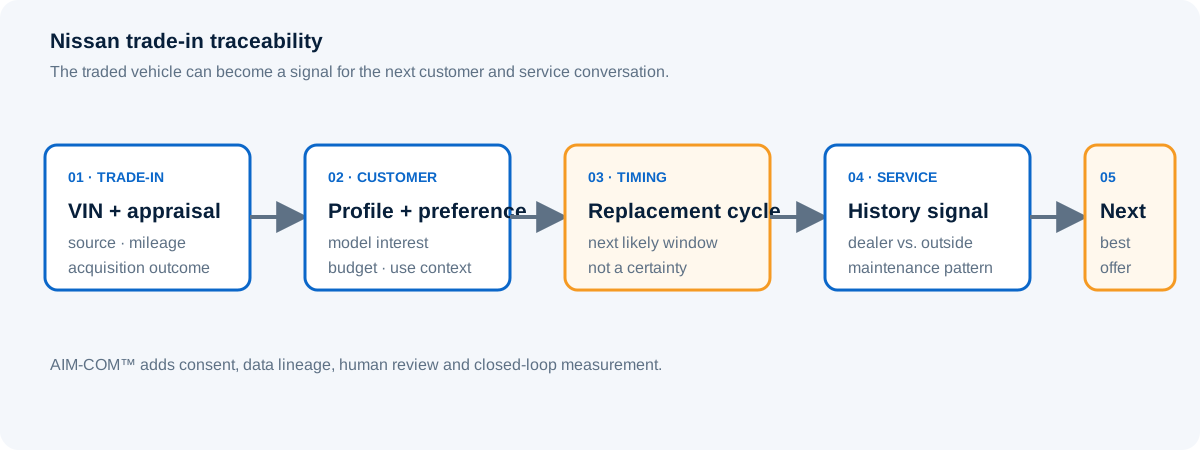
A used vehicle is not just an asset acquired by the store. It can also be a traceable signal about customer preference, timing, model replacement, service behavior and the next conversation—provided the data is available and handled responsibly.
The trade-in should not disappear from the customer record the moment the new vehicle is delivered.
What the Nissan Trade-In Example Illustrates
The program combines a customer incentive with a used-vehicle acquisition decision. The customer has to bring a qualifying trade. The trade has to meet brand and model-year rules. The customer must choose a 2026 or 2027 Nissan Frontier and complete a purchase or lease during the active window.
| Campaign element | Reported condition | Operational control |
|---|---|---|
| Benefit | Extra $1,500 through the Nissan Trade-In Assistance Program. | Confirm the active amount, program period and applicable offer terms. |
| New vehicle | Purchase or lease of a new 2026 or 2027 Nissan Frontier. | Validate model year, VIN, transaction type and delivery timing. |
| Trade requirement | A vehicle trade-in is required for eligibility. | Capture traded VIN, ownership, appraisal, source and disposition. |
| Trade brands | Chevrolet, Ford, Jeep, Ram and Toyota are listed. | Validate make, model year and applicable program rule. |
| Age rule | Trade must be less than five model years older than the purchased vehicle. | Use a date-aware eligibility matrix for 2026 and 2027 paths. |
| Limit | One offer per vehicle. | Prevent duplicate use and preserve transaction evidence. |
Conservative interpretation
The $1,500 benefit may improve the customer’s consideration of a Frontier, but the campaign page alone does not prove incremental sales, gross improvement or service retention. Those outcomes require a baseline, transaction data, inventory context and follow-up measurement.
Where AIM-COM™ Adds a Used-Vehicle Layer
AIM-COM™ could treat the trade-in as a continuing data object rather than a one-time eligibility field. The goal is not surveillance or a guaranteed prediction. The goal is to make the customer and vehicle lifecycle more visible so the dealer can plan a better handoff.
| AIM-COM™ capability | What it could connect | Why it matters |
|---|---|---|
| Used-vehicle traceability | VIN, appraisal, acquisition source, mileage, condition, disposition and resale outcome. | Shows what happened to the asset after the trade and supports inventory decisions. |
| Customer profile | Vehicle preference, household or business use, budget signals, channel and stated intent. | Supports more relevant model and service communication. |
| Replacement-cycle study | Prior transactions, ownership duration, engagement and next likely timing. | Helps time outreach around a realistic replacement window. |
| Service-history propensity | Available maintenance, repair orders, mileage, warranty and service location. | May indicate whether to emphasize dealer service, maintenance, parts or warranty options. |
| Next-best conversation | Vehicle age, mileage, service due, prior behavior and customer preference. | Gives a human advisor a more relevant reason to contact the customer. |
| Closed-loop measurement | Trade conversion, replacement timing, appointment, repair order, offer acceptance and opt-out. | Connects the campaign to retention and future improvement. |
1. Track the Used Vehicle After the Trade
The traded VIN can be connected to its appraisal, acquisition source, reconditioning status, retail or wholesale path, days-to-sale and final disposition. That creates a traceability record for inventory and campaign analysis.
AIM-COM™ could help answer questions such as: Which trade sources produce retailable vehicles? Which models take longer to sell? Does the campaign acquire the type of used inventory the dealership actually needs? Are certain regions or customer segments producing stronger trade economics?
The record should include access controls and a clear retention policy. A vehicle traceability program should support business decisions without collecting more customer information than the purpose requires.
2. Study the Customer Profile and Preference
The trade-in reveals more than make and model. It may indicate how a customer uses a vehicle, what size or capability they value, how often they change vehicles, what price range they consider and which channels brought them to the dealership.
This information can support a better next conversation, but it should not be treated as a complete profile. Customers may share vehicles, change jobs, change households or respond differently to a new need. AIM-COM™ could organize the evidence and identify what still requires a human question.
3. Estimate the Model Replacement Cycle
A customer who trades a vehicle after a certain ownership period may have a different replacement pattern from a customer who keeps a vehicle for a decade. AIM-COM™ could study prior transactions, service interactions, digital engagement and time since purchase to estimate a likely next window.
The purpose is not to send a generic message every month. It is to plan an appropriate touchpoint when the customer may be open to a new model, a trade appraisal or a service conversation. The estimate should remain a planning signal, not a promise about customer behavior.
4. Use Service History to Shape the Right Offer
Service history can help a dealer understand whether a customer has historically used the dealership for maintenance and repairs or whether most visible service activity occurred elsewhere. That distinction matters after a trade because the next service relationship may be new even when the customer has just purchased from the store.
| Available signal | Possible interpretation | Human-approved offer |
|---|---|---|
| Recent dealer service | Customer may already trust the dealership’s service department. | Maintenance plan, next service reminder or loyalty appointment. |
| Limited dealer history | Customer may service elsewhere, or the data may be incomplete. | Low-friction introduction, inspection, tire or maintenance offer. |
| Vehicle age and mileage | Maintenance or wear items may become more relevant. | Inspection, brakes, tires, fluids, warranty or service-plan conversation. |
| Open recall or due service | A safety or maintenance need may require timely attention. | Service outreach with clear customer communication and consent. |
| Strong outside-service signal | The dealership may not yet be the preferred service location. | Explain value, convenience and transparency rather than assuming loyalty. |
Service history can be incomplete when work occurs at independent shops, another dealer, a fleet provider or through a customer’s own maintenance. A missing record is not proof that the customer did not maintain the vehicle.
5. Create a Human-Approved Next-Best Service Conversation
The output should not be an automated conclusion that a customer will buy a particular service. It should be a useful prompt for the advisor. For example: “The customer traded a 2021 truck, has limited visible service history with us, and may be approaching a maintenance milestone. Consider a welcome inspection and a transparent explanation of service options.”
This approach respects uncertainty. It gives the service team context while leaving the final recommendation, timing and tone to a person who can speak with the customer.
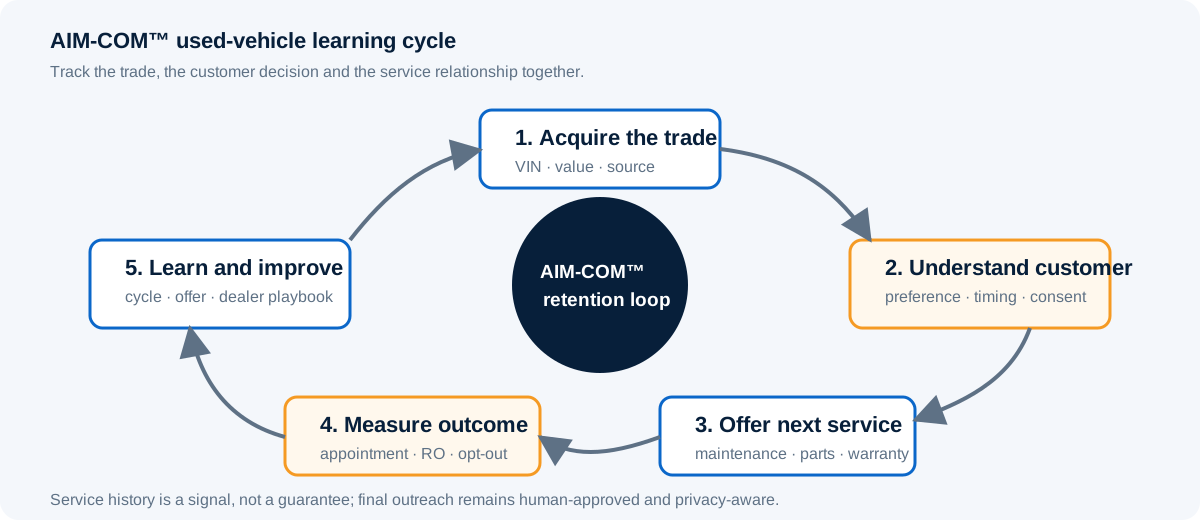
How AIM-COM™ Organizes the Full Campaign
| AIM-COM™ layer | Nissan trade-in application | Output |
|---|---|---|
| Strategy & Outcomes | Define whether the campaign is intended to move Frontiers, acquire used inventory, improve trade economics or support retention. | Clear goals and a baseline for each business objective. |
| Co-op Economics | Separate the $1,500 customer offer, dealer economics, acquisition cost, reconditioning exposure and service opportunity. | Visibility into cost and value across the lifecycle. |
| Governance & Risk | Control eligibility, VIN lineage, customer access, consent, service data, retention and exceptions. | Traceable and privacy-aware records. |
| Network Enablement | Give sales, appraisal, used-car and service teams a shared playbook. | Consistent handoffs from trade to delivery to service. |
| Activation & Operations | Coordinate offer communication, appraisal, CRM updates, service outreach and dealer workflows. | Fewer disconnected customer experiences. |
| Intelligence & Improvement | Analyze replacement cycle, service propensity, offer acceptance, appointments, repair orders and opt-outs. | A learning system for future trade-in and retention campaigns. |
AI Reporting for Trade-In and Retention
AI could summarize patterns across state, region, dealer, model, trade brand, customer segment and service path. It could flag vehicles with long appraisal-to-sale time, customers approaching a likely replacement window, service opportunities with incomplete evidence, or dealers with high trade participation but weak post-sale retention.
Illustrative AI prompt
“Analyze Nissan trade-in campaign data by dealer and customer segment. Connect traded vehicle age, model preference, replacement timing and available service history. Identify customers who may benefit from a human-reviewed service conversation, but separate missing data from evidence of outside service and do not infer certainty.”
Use role-based access, redaction, audit logs and human approval. AI may organize evidence and suggest questions; it should not decide what a customer qualifies for or make a sensitive customer judgment without accountable review.
Measure What Happened After the Incentive
| Objective | Possible measure | Question |
|---|---|---|
| Trade conversion | Eligible trade-ins, appraisals, completed Frontiers and offer usage. | Did the campaign move the intended transaction? |
| Used inventory | Retailable trades, days-to-sale, recon cost and disposition. | Did the acquired used inventory fit the dealer’s needs? |
| Customer timing | Ownership duration, follow-up window and later engagement. | Was outreach timed to a plausible replacement cycle? |
| Service retention | Appointments, repair orders, maintenance acceptance and opt-outs. | Did the dealer earn a service conversation after the trade? |
| Data quality | VIN match, missing history, profile completeness and consent status. | Can the team explain the basis for the next action? |
| Unmet objectives | Low regions, weak segments and offers that were not accepted. | What should change in the next campaign? |
Dealer Research and Lessons Learned
AIM-COM™ could support interviews with sales, appraisal, used-car, BDC and service teams. The research should ask whether the offer was understood, whether the trade rules were easy to validate, whether the VIN and customer data moved cleanly between teams, whether the service handoff happened and whether customers responded to the follow-up.
Lessons learned should preserve more than the final sales count. They should include trade quality, service-data completeness, replacement-cycle accuracy, offer acceptance, customer friction, dealer adoption, outside-service uncertainty and the reasons customers opted out or did not return.
The Bottom Line
The Nissan Trade-In Assistance example creates a commercial reason to bring a used vehicle into the dealership and move a customer into a new Frontier. AIM-COM™ could help extend the value of that moment by tracing the used vehicle, studying the customer’s preference and replacement timing, analyzing available service history and supporting a more relevant next conversation.
The methodology does not turn incomplete data into certainty. It creates a disciplined way to separate known facts, useful signals, missing information and human decisions.
The strongest trade-in campaign is not only the one that closes the new-vehicle transaction. It is the one that leaves the dealer with a better understanding of the customer, the used asset and the next service opportunity.
A trade-in is a transaction. Its data can become a relationship signal.
Frequently Asked Questions
What is the Nissan Trade-In Assistance example?
The referenced dealer campaign offers an additional $1,500 when a customer trades an eligible vehicle and purchases or leases a qualifying 2026 or 2027 Nissan Frontier during the program period. Current terms must be confirmed before use.
How could AIM-COM™ track the used vehicle?
AIM-COM™ could connect the traded VIN, appraisal, acquisition source, mileage, disposition, customer profile and later outcomes while applying appropriate access, consent and retention controls.
Can service history predict where a customer will service?
Service history may indicate a pattern, but it can be incomplete when work occurs outside the dealership. It should support a human-approved conversation, not be treated as a certainty.
What can AIM-COM™ measure after the trade?
The methodology could connect trade-in conversion, replacement timing, service appointments, repair orders, offer acceptance, retention and opt-out behavior into a closed-loop learning system.
Reference
Nissan Trade-In Assistance Program example. Offer amount, model years, trade brands, expiration and eligibility should be reconfirmed with Nissan and the participating dealer before use.
Turn trade-in data into a better customer relationship.
AIM-COM™ helps dealer networks connect trade-in campaigns, used-vehicle traceability, customer timing, service-history signals, privacy-aware AI reporting and measurable retention outcomes.
Explore the AIM-COM™ Approach